Monday, June 4, 2012

Q&A with a Marshall Blogger

The last couple weeks, we've been fortunate enough to do some question-and-answer sessions with a Charlotte 49er Blogger as well a UT - San Antonio Blogger.  Today we get to post another session with a future Conference USA member - a blogger who follows Marshall University.  As was the case with the other responses, the guys at Marshall Thundering Blog provided some dynamite answers.  In addition to reading their content at their website, you can follow MTB on Twitter at @MarshallTBlog.

Obligatory "We Are Marshall" reference.  As you'll read, there's more to Marshall football than just this.
We hope to reach out to bloggers of other schools and will post whatever we can get.  For now, I've got to get this ODU-to-CUSA-story finished.

Without further ado, below is a Q&A with a Marshall blogger!

VBR: Please provide background on your association with Marshall. Did you and/or family attend? If not is it simply the local school that you support? That kind of information.
MTB: I attended and graduated from Marshall University in the late 2000’s. Prior to that I had no association with the school but, I thoroughly enjoyed my time as a MU student. I am currently an active member of the Big Green, Marshall’s athletic fundraising arm.
VBR: Assume that everyone reading this post has seen "We Are Marshall" or at least knows the story. How did the university get football back to national prominence over the years? How was the school able to recruit talents like Moss, Pennington and Leftwich that helped move the school from D1aa to D1a?
(VBR Productions note - at the time Marshall swithced to FBS, FBS was still called "D1" and FCS was still called "D1aa."  Technically it's correct to use the term "D1" as that was the appropriate name at that time.)
Thundering Herd football is played at John C. Edwards Stadium. (Photo source: Marshall.edu)
MTB: Marshall had a long and arduous path to football respectability after the plane crash in 1970. No college football team lost more games during the 70’s than the Young Thundering Herd. In fact, Marshall did not record a winning season until 1984, finishing 6-5 under Stan Parrish.
After '84 the school saw unprecedented success with it’s football program, winning two 1-AA national championships 1992 and 1996, while finishing runner up in 1987, 1991, 1993, and 1995. Marshall jumped to 1-A, now FBS, in 1997 and won four straight Mid-American Conference championships (97’-2000). During that time the 1999 team, lead by quarterback Chad Pennington, accomplished an undefeated season, finishing 10th in the Coaches and AP poll.
Marshall continued it’s success into the mid 2000’s under head coach Bob Pruett. While leading the Thundering Herd (1996-2004), Pruett won a 1-AA national championship, completed two undefeated season, claimed six conference championships, and five bowl game victories while accumulating an overall record of 94-23.
It’s funny, all the former Marshall players you mentioned, Randy Moss, Pennington, and Byron Leftwich have unique recruiting stories.
(VBR Productions note: Randy Moss will forever have a special place in our hearts after giving this "straight cash, homie!" impromptu interview.)
Out of high school Moss accepted a scholarship to Notre Dame but was denied admittance. Considered a transfer student because he signed a letter of intent, Moss headed to Florida State where he was required to sit out one season. While sitting out Moss tested positive for marijuana and was dismissed from FSU. Needing a place to play immediately the West Virginia native transferred to Marshall which was entering it’s last year as a 1-AA program. The rest is history, as member of the Thundering Herd Moss recorded over 3,000 receiving yards and 54 touchdowns over two seasons. He was also Marshall’s first Heisman Trophy finalist in 1997.
(VBR Productions note: Moss was an absolute beast.  Maybe you've seen the following clip...)
Pennington was lightly recruited out of high school and only appeared on Marshall’s radar after attending a football camp run by then current head coach Jim Donnan. Entering the 1995 season Pennington was going to be redshirted but, three injuries at the quarterback position rushed him into action. After leading Marshall to the 95’ 1-AA championship game Pennington was redshirted in 1996, making way for University of Florida transfer Eric Kresser. The future 1st round NFL draft pick reclaimed the starting spot from 1997-1999, throwing for 13,423 yards and 115 touchdowns.
Leftwhich was another diamond in the rough. Marshall only noticed the Washington D.C. product while scouting another player during a high school all-star game. Entering the 2000 season Leftwhich had big shoes to fill as Pennington had moved onto the NFL. In the end Marshall fans could not have asked for a better replacement, as a three year starter he amassed 11,903 passing yards and 89 touchdowns. In the 2003 NFL Draft Leftwhich was selected 7th overall by the Jacksonville Jaguars. 
(VBR Productions note: remember THIS effort by Leftwich?)
 
VBR: Discuss the evolution of Marshall joining Conference USA. (I believe Marshall was in the MAC for part of its existence but I'm not sure if it was part of other conferences between the MAC and C-USA.)
MTB: Marshall was expelled from the MAC in 1969 due to major NCAA violations so rejoining the conference in 1997 was a big deal. During it’s second stint in the league Marshall won five conference football titles and became a regular on ESPN . After losing four members to the Big East in 2004 Conference USA was looking for new schools to fill the void. With a nationally recognized football program Marshall was an easy choice for C-USA and the Thundering Herd joined up in 2005.
VBR: What are your thoughts on Old Dominion joining the conference? What could ODU's administration learn from Marshall's move from D1aa to D1a years ago?
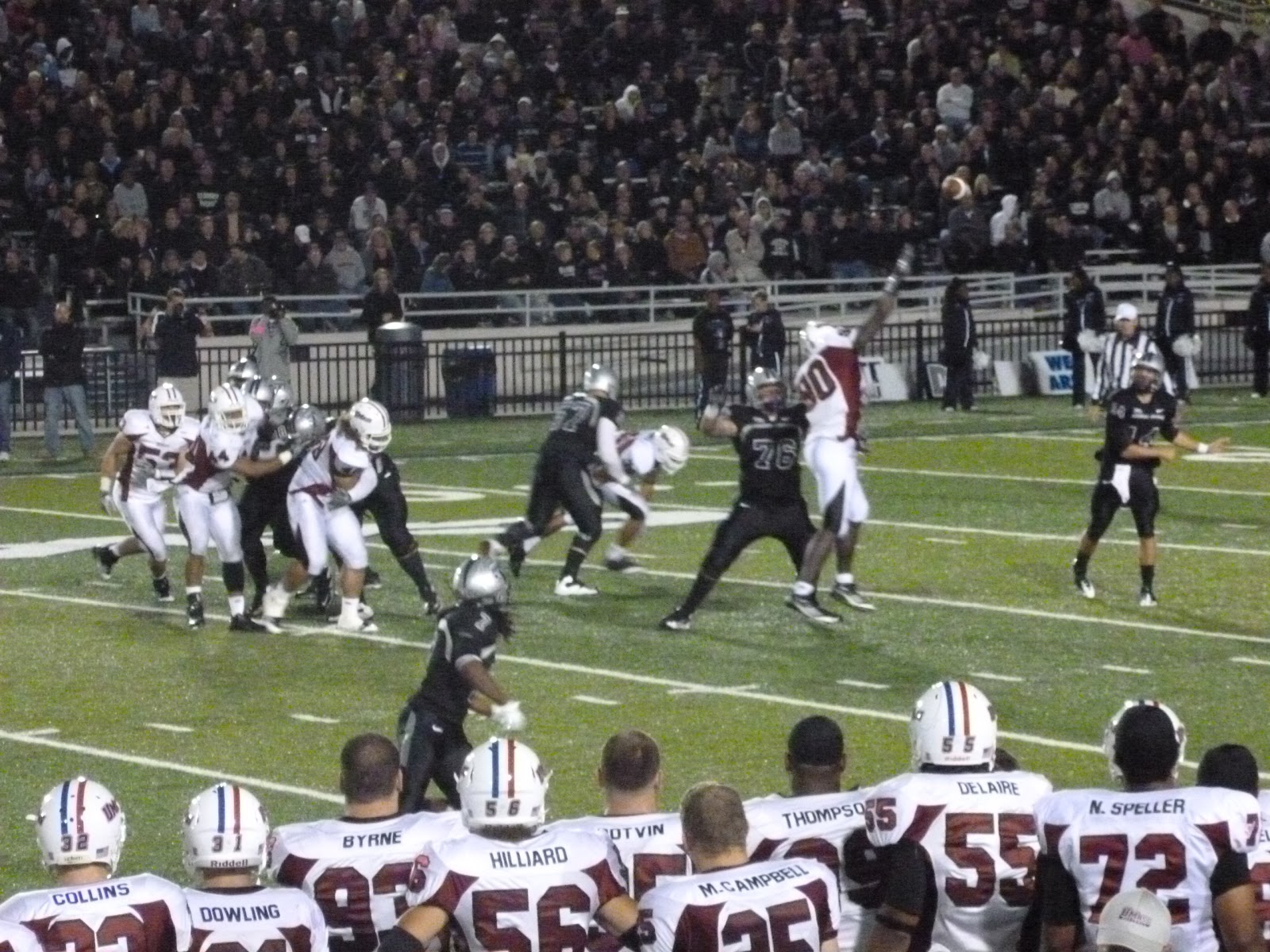
Gratuitous Old Dominion football picture.
MTB: Love the addition of ODU to Conference USA. As a Virginia native I am very familiar with the school and it’s start-up football program. ODU is an easy travel partner for Marshall and I look forward to attending away football and basketball games.
Comparatively, ODU is in a much stronger position to make the jump from FCS to FBS football than Marshall was in 1997. I don’t mean that in a talent on the field type of way. Keep in mind Marshall made the jump off a 1-AA national championship with Randy Moss and Chad Pennington in tow. What ODU has going for it is money and resources. I might be wrong but, I think ODU’s athletic budget is bigger than Marshall’s. Also, ODU resides in a much bigger media market and recruiting hotbed than Huntington W.V.
What ODU football coaches should be looking for is their own version of Randy Moss. In 2014 the Monarch’s can offer FBS transfers the ability to play right away and the promise of returning to big time college football in one year. That special opportunity needs to be exploited.
(VBR Productions note: seriously...Randy Moss was good.)
VBR: What were highlights of the 2011 football season, and what is your outlook for the 2012 season?
MTB: Marshall returned to a bowl game after a one year hiatus, defeating FIU in the Beef ‘O’ Brady’s Bowl 20-10. Finishing 7-6 might not seem great but, The Herd had it’s best league record since joining C-USA, finishing 5-3 with big victories over ECU and Southern Miss. Marshall also recorded an away win over Big East member Louisville. The win was MU’s first over a BCS conference school since defeating Kansas State in 2003.
Marshall hosted C-USA’s defensive player of the year in 2011, former defensive end Vinny Curry. A senior Curry was selected in the second round of April’s NFL draft by the Philadelphia Eagles.
The Thundering Herd returns a young squad in 2012 with only six seniors. Despite their youth many of Marshall’s underclassman have played a lot of football.
On offense second year quarterback Rakeem Cato looks to improve on his true freshman season. The Florida product threw for 2,059 yards last year while tossing 15 touchdowns and 11 interceptions. Cato will have the luxury of throwing to West Virginia native Aaron Dobson who snagged 49 balls for 668 yards and 12 TD’s in 2011. Marshall also returns two running backs, Tavon Vann and Tron Martinez (name should be familiar to ODU fans) who both rushed for over 500 yards last year. Along the offensive line the Herd must replace two starters at left and right tackle.
Showing clear improvement during 2011, Rakeem Cato threw for 341 yards and two touchdowns in a 34-27 OT win over East Carolina.
On defense the Herd is replacing starters at defensive end, linebacker, and safety.
A group of young defensive ends are fighting to fill the void left by Curry. Marshall does have a deep group of defensive tackles, Brandon Sparrow, Marques Aiken, Steve Dillon and Jarquez Samuel that from a solid rotation. At linebacker the Herd will be elevating two former reserves to starting spots. One player to watch out for in the secondary is safety D.J Hunter. Hunter was originally headed to Tennessee out of high school but, legal issues derailed his career before ending up at Marshall. He received rave reviews during spring practice and should be a force once the season starts.
VBR Productions thanks the guys at Marshall Thundering Blog for their responses.

Tuesday, May 29, 2012

Q&A with a UTSA Blogger

As Old Dominion approaches its final season as a member of the Colonial Athletic Association, we're trying to get familiar with their future Conference USA opponents.  Recently we shared a Q&A with a Charlotte blogger, which you can read by clicking this link.

While most Monarch fans are more familiar with a school in a neighboring state, they may know less about some of the more-distant schools.  In limited time I've reached out to a couple bloggers of those schools.  The gentlemen at Coker Chronicles were kind enough to respond with some background on the University of Texas - San Antonio, which we're sharing here.  (If you question how "Coker Chronicles" is an appropriate for a blog centered on the Roadrunners, read below for the discussion of their head coach.)


The Roadrunners' inaugural football season was 2011.  (Photo source: UTSA.edu)


The content that Adam and Jared provide at their website is impressive and worth visiting regularly.  You can also follow Coker Chronicles on Twitter

(Unrelated to UTSA: it's taken me some time but I think I've got my angle to express my thoughts on Old Dominion's change in conferences.  I hope to have that blog post available by the end of the week.  It's not easy to articulate two decades of association with the Association.)

Without further ado, here's a Q&A with Adam of Coker Chronicles!


1. What is your association with UTSA?
 

Adam: I am a San Antonian. I lived in the city until I left for Denton, TX and the U of North Texas. My support of the program was largely born out of my love of my hometown. I do plan on attending graduate school come fall, so I will have a more solid connection, soon.
 

Former Towson, CAA great Gary Neal is a key part to the San Antonio Spurs' current NBA title run.  (Photo source: CNNSI.COM)


2. What are some Road Runner athletics accomplishments outside football?

Adam: Basketball, as under-appreciated as it is, has brought the most fame (and relatively decent fortune) for the program. The program has three trips to the NCAA tournament to it's name and a win to boot. Devin Brown, the former NBA and current D-League player, is probably the most accomplished of the program's alumni.

Also of note? The track and field team won the Southland Outdoor and Indoor championships this year also.
 
Devin Brown in action for the Hornets.  (Photo source: NBA.com)

 
3. Talk a little about how football started - has there always been a clamoring for D1 football? Did a couple large donors come through with big checks or was there a groundswell of support? How important was it getting Larry Coker as the first coach?

Adam: There has always been a low rumble of support for football in the city. (http://www.cokerchronicles.com/2012/03/wayback-machine-1971-article-on.html) I think the recent wave of support that culminated in the reality was due to a collision of factors: 1) An Athletic Director (Lynn Hickey) with the talent and ability (and connections) to make it happen, B) A sense of possibility from the city leaders. The Alamodome is 20 years old and everyone realizes now that an NFL team won't be using it as a home stadium without major renovations -- but it is perfect for a college football team. The university, lacking major funds to build a stadium and the necessary facilities only needed to solicit donors to fund the latter. With the Alamodome a viable option (and a resounding success as a home venue in hindsight) it suddenly was much easier to convince those donors to write checks. After all, it is much easier to write a check for a coach than it is to get a stadium built.

Larry Coker was a genius hire. Although largely seen as a failure after his time in Miami, he is exactly the kind of coach the fledgling program needed. He isn't likely to be hired away, has the cache of a championship-winning coach, has tons of experience at various programs, and also has a desire to prove himself.
 
(VBR Productions note: Coach Coker visited Bobby Wilder during 2010 to get a look inside ODU's own start-up program.  You can read Rich Radford's article on the encounter by clicking here.) 
 
4. What were some highlights of the first season? What did the administration do right to get an average attendance of 35K in its first season?
 
 
More than 56K attended UTSA's first game 9/3/2011. (Photo source: MySanAntonio.com)

 
Adam: I think the obvious highlight was Eric Soza's scamper for the first ever touchdown in the program's history. The entire opening quarter was perfect (in which they scored on the first 3 possessions); video can be found at the following two links: http://www.goutsa.com/mediaPortal/player.dbml?id=797188&db_oem_id=13100 and http://www.flickr.com/photos/66994849@N03/6131957120/in/pool-1796644@N22/. Personally, I feel that spurred some of the subsequent attendance numbers.

Though I credit most of the attendance figures to the fans, the administration did well to not hinder the enthusiasm. They did a marketing blitz and made it easy for the average fan to know about the games, and get tickets. Similarly, they made sure they students could get to the games and back to campus without having to figure out their own transportation.

5. What is the evolution of UTSA joining Conference USA? How do you and other fans feel about Old Dominion joining the conference?

Adam: The evolution of UTSA's bid to the conference is a long one involving back-stabbing and board room meetings at much higher levels. UTSA is definitely a beneficiary of the major BCS shakeups we've seen the last few years ( and really going back to the 60s). With CUSA and MWC looking to strengthen their position in light of so much conference realignment, they looked to form an Alliance (and still do). With the sudden need for teams --and TV markets -- the addition of UTSA didn't seem so ridiculous. Whereas some CUSA presidents dismissed the program as too new for membership now, it seems CUSA is looking to the future with the addition, basically stealing UTSA away from the Sun Belt to everyone's delight (witness TxStates' anger at having to be associated with that conference.)

 
Gratuitous picture of Old Dominion football.
 
 
ODU's addition has been drowned out by the euphoria surrounding the move. I do know that the admin looked to ODU as something like a how-to-build-a-program. Going forward the two schools are likely to be in different divisions, so I doubt there will be as much sports hate between the schools as there will be for inter-division and in-state rivals.

6. What is your outlook for the 2012 season under Coach Coker?
 
 
Adam: If anyone wasn't exactly thrilled with the rapid pace of movement to FBS status, it was Larry Coker. He has to do the grunt work of finding and molding a rag-tag squad of cast-offs and first timers into a competitive team. Most programs have something like a 10-year learning curve to ramp up with. Coker has had only one class come in post-inaguaral season. It is with that knowledge that I am withholding judgement. I fully expect to see some terrible games in which the Roadrunners are dismantled and outclassed. However, this team/program has consistently exceeded expectations so I reserve the right to be pleasantly surprised.


Wednesday, May 23, 2012

Q&A with Charlotte Blogger

So...Old Dominion University announced it was leaving the Colonial Athletic Association for Conference USA on May 17, 2012.  You can read my take on the fooball aspect of it by reading my story for SaturdayBlitz.com

(I am putting together a comprehensive blog post about the move.  Surprisingly it's not all puppies and rainbows for this blogger.  I think it was the correct decision for the long term, but there are concerns.  I hope to bore you with an introspective story posted by the end of the holiday weekend.)


Old Dominion to Conference USA.  It's happening.


Less than a week before ODU's announcement, I was asked to provide some background on ODU's football program by a fan of the Charlotte 49ers.  The blogger wanted some insight into what Old Dominion did correctly to have finished its first three seasons with records of 9-2, 8-3 and 10-3.  I was more than happy to oblige, because I'm just a swell guy.  

The success of the Football Monarchs was relevant to Sydney and his blog because UNC Charlotte (or "Charlotte", or whatever the correct moniker is - I'm not intentionally trying to be offensive but I think that "UNC-C" is not acceptable by their fans) announced it would field an intercollegiate football team in 2013. 

The short version is that when this decision was announced a few years ago, their administration expected to compete as an FCS independent team but recently got an invitation to join Conference USA.  Accpeting this invitation meant that the 49ers would play FBS football in 2015 after two years as an FCS independent.  It had previously belonged to C-USA but switched to the Atlantic 10 Conference, essentially because it didn't field an intercollegiate football team. 

At this point, I'm done trying to make sense of conference changes.  This is not meant to say that any change is a mistake; there are simply too many changes to make appropriate assessments right now.  Just know that (for now) Charlotte and Old Dominion will join C-USA as football programs in 2015. 


I asked Sydney if he'd answer some questions about Charlotte for my own blog.  The 49ers aren't as unknown to Monarch fans as UT - San Antonio might be, but it's not as familiar as George Mason, either.  I've reached out to a couple other bloggers of Conference USA schools and hope to get their Q&A's posted over the next couple weeks.

So with that background, I provide you a Q&A with Sydney of 49ergreen.com.  In addition to reading the blog, you can follow Sydney on Twitter at @49erGreenBlog.  Enjoy!

1. Please provide the reader some background about yourself: are you a graduate of Charlotte, when did you start following, etc.?

I am actually not a graduate of Charlotte; I went to a smaller private college up north and graduated in 2007 with a bachelor's in digital media arts. I moved to Charlotte in 2009 and started following 49er sports shortly after. In addition to having family work for the school I am also involved as a volunteer staff member with a couple of religious organizations on campus so I am there quite frequently. The main sports I attend are soccer, basketball and baseball (and definitely football in 2013).

2. What are some of your favorite memories of 49er athletics?

I would have to say my favorite memory of 49er athletics has to be the men's soccer team and their College Cup run of 2011. Although I am not a student or alum just seeing the fans get behind the team was unbelievable. I watched the national championship game with others on campus (which Charlotte lost to UNC, 1-0) and it was just great to see that much support for the team (I know soccer gets a rap for not being a popular sport, but the national attention the school got continues to this day).

Charlotte fell to UNC in the NCAA men's soccer national championship (photo courtesy Charlotte49ers.com)


3. Describe from a fan's perspective what it is like to switch from Conference USA to the Atlantic 10, then back to C-USA. How would you describe the 49ers' performance in the A-10?

Over the past couple of years, the 49ers have done fairly well in the A-10 as a whole. I already mentioned men's soccer, but baseball has been one of the top teams in the country over the past several years (despite an off year in 2012) and have always competed near the top of the league --even winning a couple conference titles. Track and field, golf and cross country have won multiple conference championships, and even softball has done reasonably well. 

However, the clear headline sport is basketball, and over the past few years, it hasn't been good. The Niners missed the conference tournament in 2010-11 before making it as the 12th seed (out of 12) this year; however, they were one and done. They've been slipping over the past three or four seasons or so, and part of that is the fact that the A-10 tends to be such a top-heavy conference. Outside of Xavier and Temple, and maybe Dayton, Richmond, Saint Louis and St. Joe's (when those four are doing well), there's not really any teams that consistently challenge for the top spot (outside of St. Bonaventure). You can make a case for clubs like George Washington (who had a couple of phenomenal seasons a few years back), UMass, Rhode Island and Duquesne, but they've been middle of the pack teams at best of late. While the case is made that the new C-USA will be much weaker basketball-wise, it ushers in a little more parity among the teams involved.

4. What are your thoughts on Old Dominion athletics in general, and football in particular? What does it mean for Charlotte to be in the same conference as ODU as well as East Carolina?

Gratuitous picture of Old Dominion football.


I honestly haven't followed ODU athletics too closely, so I can't really get in to that much detail. I do know that the football team has done an amazing job in such a short time, and it remains to be seen if that success can be replicated at the next level. If so, the face of the conference (and college football as a whole) will definitely change -- but of course, that's a big if, and there are no guarantees. I do think that ODU and Charlotte will be able to really feed off each other if one or both are successful. With that said, it's great to be in the same conference as ECU -- it's an automatic, natural geographic. The drive between Charlotte and Greenville is very doable (although I have yet to make the trip myself), there are many ECU fans and alumni in Charlotte, and I hope that both schools will develop this rivalry to the fullest extent.

5. ARE YOU READY FOR SOME FOOTBALL??? (And more specifically, what will a football program do for Charlotte as a university?)

Football will put Charlotte on a whole new level, not only from a financial standpoint but also an enrollment standpoint as well. Interest in the school has increased since the football program was first announced, and will stand to grow if the team is successful. Local football players now have another option to turn to if they want to continue to play in college; they now have the choice to maybe get more playing time here than they would at a bigger college. Financially, the college stands to benefit from merchandise, ticket sales and seat licenses, and the more successful the team is, the more money comes in. It is truly a great time for all Charlotte sports fans, and it only stands to get better down the road.

Charlotte 49er Football.  It's happening.  (Photo courtesy Charlotte49ers.com)


VBR Productions humbly thanks Sydney for his input on the 49ers in this blog.

Sunday, May 13, 2012

Hole Hearted: No Ordinary Love Song

(Author’s note: Posts like this one are the reason I gave my blog the title “VBR Productions.”  It allows me to write about more than just sports.  Had I called it something more specific like "A Sports Fan’s Blog,” I wouldn’t be able to share the below thoughts.)


Everyone has a favorite band and/or song.  Over time, and as with all things, these bands and songs may change as people’s tastes change.  There may be better bands and songs that come along, while individuals go through different phases in life.  I went through a jazz phase where I only wanted to hear Ella Fitzgerald, Miles Davis and Count Basie.  It’s a natural progression.


This blogger’s favorite band has always been Extreme.  In a future post I’ll go into the how’s and the why’s; for now the reader need only know that they’ve been my favorite band forever, no matter the point in time.


In 1990 the band released “Extreme II: Pornograffitti,” a rock album that reached double platinum status and peaked at #10 on the Billboard 200 chart.  Although the majority of the album centers on Nuno Bettencourt’s other-worldly guitar playing, the band became known for “More Than Words.”  The slow ballad was unique at the time, as it incorporated only two vocalists and an acoustic guitar. 


But “More Than Words” is not the lone acoustic-only track on “Porno.”  While “MTW” gained the band fame and fortune, it was “Hole Hearted” that proved to be the superior song.  In fact it remains my favorite song more than two decades later.


The purpose of this blog post is to break down reasons “Hole Hearted” is among the greatest love song of modern rock and roll.  First, give the original studio version a listen before continue reading.  No analysis would be worthwhile if the song isn’t fresh in your mind, and if the song just doesn’t get you to tap your feet, then me writing about it isn’t going to change that.  (I'll also provide other versions of the song throughout the post, if for no other reason than to break up the prose.)


So where do we begin deciphering the consolidation of awesomeness that we just experienced?  Let’s start with the dynamics of the lyrics and music, and then examine a few subtle aspects of the song.


Lyrics and Music
(Preface - I grew up playing the guitar and this song is the reason I kept playing when I was about to give it up.  The below discussion incorporates chord progressions and notes, but hopefully you can still get through it if you can't read music.)


The song opens with roughly 30 seconds of instrumentals that build the foundation of the entire song.  Nuno begins with a series of “D,” “E” and “F” chords that lead into a sequence of him strumming single-and-dual notes centered on the “A” and “D” chords.  The first words sung are not awe-inspiring: Gary supplies variations of “ooh, yeah,” “woo!” and more “yeah’s” as the music commences. 

The first chorus sets the scene from the first-person perspective: there’s something missing in his life.

"Life’s ambition: occupy my time //
Priorities confuse the mind //
Happiness: one step behind //
This inner peace I’ve yet to find"

The words themselves are melancholy but are set to a positive-sounding musical riff.  This dichotomy establishes a sense of longing coupled with hope.  Specifically, the last word of the verse (“find”) is sung to the strike of the “D” chord, which is an upbeat progression from the “A” chord dominating most of the verse.  The word “find” itself carries the connotation of potential discovery, which is an exhilarating event.

Following this establishment of hope, a bridge follows to connect the verse to the chorus.  The up-and-down flow of the music matches the mood of the words:

"Rivers flow into the sea //
Yet even the sea is not so full of me //
If I’m not blind, why can’t I see //
That a circle can’t fit in where a square should be?"

The first line is played on the upswing – “Rivers” is sung to the “D” chord, while a higher-octave “G” is struck with the next word (“flow”).  Following a lower-octave “G” and “A” chords, the second line follows a sequence of “A7” to “D7” to “C7” back down to “A7.”  It’s no accident that this less-upbeat sequence of chords matches lyrics emphasizing the singer’s recognition of emptiness (“the sea is not so full of me”). 

The third line again starts on a good note (“D” chord) followed by a “G” of a higher octave.  However, even this higher-octave chord is a “G7” rather than the full “G.”  This lack of a full “G” is consistent with the tone of the lyrics, which simulate of a lack of comprehension of his loneliness. 

Just as the third line is musically similar but not an exact replica of the first, the fourth line imperfectly mirrors the second.  The lyrics match the sadness of the second line but the chords form a more melancholy-filled “C7” – “A7” – “D” – “A7” sequence.  This chord progression allows the bridge to end with sadness both lyrically (things can’t fit where they don’t belong) and musically (chord progressions inspiring sadness).

So the first verse ends with hope, while the bridge ends on more of a downer note.  The lyrics are ambiguous enough for the audience to apply them to any situation (not necessarily love). Meanwhile the nature of the music (fast-paced acoustic guitar, accompanying bass guitar, and a single drum beat) is simply a fun, toe-tapping ditty.  Nothing about the first 74 seconds of the song points specifically to a love song.


And then, BOOM!  Well, it’s more of a subdued “boom” that occurs; there are a couple louder “booms” that occur later.  The “A7” that concludes the bridge gives way to a simple “G” chord followed by a quick “A” – “B” – “C” chord progression.  These chords match the following lyrics:

“There’s a hole in my heart that can only be filled by you.”

That Cherone sings the first ten words of the chorus by himself is consistent with the sad tone of the end of the bridge.  Nuno jumping in to sing with him on the two words “by you” represents the first indication that this is a love song.  These words are followed by the “D” – to – “E” chord progression that opened the song, but are decidedly more active than the ambiguity of the intro.

In a less-subdued manner, the rest of the band joins Gary and Nuno in singing the second (of two) lines of the chorus:

“And this hole my heart can’t be filled with the things I do…” 

What an explosion of vocal ability!  Each band member hits his note perfectly.  This is the part of the song where if you aren’t hitched yet, the rest of the song probably won’t do it for you.

And yet the chorus is not yet complete.  Following this positive convergence of guitars and vocals, Gary is left alone (emphasizing first-person loneliness) to sing the two words, “hole hearted.”  The guy has a hole in his heart for a woman, acknowledges the situation, but also knows he can’t do anything about it without her help.

Before moving to the interlude/guitar solo, it is time to mention the play on words of “hole hearted.”  To state the obvious, it’s a play on the words “whole-hearted,” which describes someone’s inclination to give an undertaking everything he’s got.  Conversely, the singer is operating “hole-hearted,” whereby a lack of something prevents him from being whole.

If that’s not a clever turn of a phrase, I don’t know what is.

After Gary repeats “hole hearted” a second time, the song leads to Nuno’s guitar solo.  With the main guitar riff from the first verse in the background, Nuno introduces a “slide” tool into the song.  This provides a smoother “twang” sound to guitar strings than does the pressure of human fingers.  There’s no need for deep analysis of this – it’s an upbeat, fun addition to the song.  The live version below makes excessive use of a slide guitar...and it still works.


With the slide guitar continuing into the second verse to complement the lyrics, the song gets back to being as fun as it was at the start of the bridge.  Let’s shift the focus back to the lyrics of the second verse:

“This heart of stone is where I hide //
These feet of clay kept warm inside //
Day by day, less satisfied //
Not fade away before I die"

In contrast to the first verse, in which the musical tone matched the lyrical tone, the use of the slide in the second verse presents the opposite tone of the lyrics.  The harsh words (including “heart of stone,” “less satisfied” and “die”) are surprisingly offset by the “zip” of the slide guitar.  Gary practically crying the words of the third line, to the tone of an imploringly-high note, is even negated by the immediate response of Nuno’s guitar. 

On the whole, musically and vocally, this song has established a fun, upbeat momentum to this point.  There’s been impassioned singing, glorious harmonization of vocals, both simple chords and complicated guitar riffs, and the use of a guitar slide.  All this leads back to the bridge, which lyrically is exactly the same but musically incorporates the aforementioned momentum.

The first line is sung similarly to the first bridge, but Nuno sings the second line with notably more fervor than the first time.  He even completes the line by ending the final word (“me”) by singing a couple notes up the scale.  We’re building to something here!

Nuno then joins Gary on the third line by singing a harmonizing descant (more momentum!).  The fourth line is again sung by Nuno with drastically more fervor than he sang it in the first bridge.  Gary even joins him to end the line with a spirited “should be!”  All during this bridge, the slide guitar abounds and dances about, matching and offsetting the lyrics throughout.  Such things cannot be appropriately articulated – the combination of vocals and slide guitar simply creates amazing music.

The song begins its final movements when Gary sings, “there’s a…” and is majestically joined by the others with “hole in my heart that can only be filled by you!”  Pat shows off his vocal prowess by singing the high “A,” “B” and “C” notes to match “that can on-,” then maintains the high “C” at “-ly be filled.”  This is followed by another vocal burst of “and this hole in my heart can’t be filled with the things I do.”

Rather than finish the line with “hole hearted,” the first line of the chorus repeats itself.  The final line becomes “I should have known from the start I’d fall short with the things I do hole hearted.”  Gary and Nuno alternate singing the words “hole hearted” a couple times before Gary begins the final sequence.  The band ends the song on an upbeat “D” chord with more harmonizing of the word “hearted.”  A few seconds later Gary concludes with a mild, almost inaudible, “yee-haw” that accentuates the musical explosion that just ended.

So what did we all just witness?  The song repeats a set of four specific movements: instrumental foundation, verse, bridge, and chorus.  Within the first and second sequences, the song establishes an understated tone of loss coupled with the chance of hope.  The third sequence uses upbeat music to compensate for the down mood of the vocals.

The song culminates in a chorus where the tone of the music has shifted somewhat melancholy lyrics into a celebration.  The singer needs the object of his affection, and we’re made to feel how amazing that person is through the synchronization of music and vocals.

Subtle Measures

Three other aspects that are less pronounced require discussion: lack of electronic instruments, the song’s drum beat and the song’s role in “Pornograffitti.”

Acoustic-Only Instruments
Musicians can neutralize deficiencies in talent through the use of electric guitars, synthesizers, and other electronic measures.  Just throw enough distortion into your amplifier and you can make garbage sound a little less like garbage. 

What continues to strike me about “Hole Hearted” is that there are no electronics involved.  There is a full sound to the song, and it’s almost jarring to think that it is comprised of bare-bones acoustic guitars, two drums (see below) and vocals.  There is no lack of sound whatsoever to this song.  To get that rich of a song musically without the aid of electrical instruments underscores the talent of the band.

Below is an early-90's version of the song using electric guitars...and a four-piece horn section!  (The first two minutes are are a slow interlude, but the payoff is worth it.)


Drum Beat
One musical element subliminally enhances the “love song” aspect of “Hole Hearted.”  After Nuno strums his guitar the first couple seconds of the song, we are introduced to the beat of the bass drum.  This beat occurs at a rate of almost two beats per second and continues until the last note of the song.  There’s a cymbal Paul uses throughout the song as well, but it used sparingly.

The key to this drum beat is that it is continuous throughout the song, no matter the movement.  The musical interludes, verses, bridges and choruses all maintain the same, unending beat.

You know what else is associated with a regular beat?  You got it – a heart!  While heart rates can fluctuate (due to exercise, or even the from the flutter of love), generally they beat at a constant rate.  (In fact, you don’t want your physician to classify your heart beat as “irregular.”  It’s considered bad in the medical community.)  A song (about a hole in one’s heart) itself has a beat that does not deviate from its course throughout the song.

It’s rather poetic…kind of like a love poem.  The next live version by Gary's side project, Hurtsmile, emphasizes a stronger demonstration of percussives.


A Funked Up Fairy Tale…

Two decades ago, bands put significantly more emphasis on completing entire albums of quality songs.  Nowadays it seems like bands and artists focus on getting one hit single out to the market and cash in on their popularity.  (That’s not an indictment of today’s music, just an observation.)

“Hole Hearted” is the 13th and final song on their second album, “Pornograffitti.”  It was a fairly ambitious funk-based rock album that explored the objectification of people for sex (a song called “Pornograffitti”), greed (“Money [In God We Trust]”), and chauvinism (“He-Man Woman Hater”).  “Hole Hearted” is not the only love song, as “Porno” also includes “When I First Kissed You” and “Song for Love.”  However, even the album’s most popular love song (“More Than Words”) can be broken down by saying, “if you truly loved me then you’d sleep with me.” 

The vast array of music meanders on the topics of sex, exploitation, etc., throughout the album.  There’s not a linear progression of topics – they just meld together in no particular order.  So concluding this album on such a powerful, clever love song allows the listener to question what he/she just heard.  Cognitive dissonance sets in – the entire album was all over the map about sexuality, and yet it ends on a note of such genuine affection?

By listening to the song as a single, the listener can get everything out of “Hole Hearted” as was discussed above…except for the jarring effect of how it concludes “Porno.”  But listening to the album from cover to cover generates that much more depth and meaning for the listener.


Here's a sample of "Porno's" essence.


In conclusion, “Hole Hearted” is about as unique a love song as you’ll hear.  On the surface, it’s just a good song sung by a talented band of musicians.  Under the surface, its complicated lyrical and musical ebbs and flows add depth to the actual words and chords.  As part of the overall picture, it rather dramatically concludes an album that emphasizes sexual exploitation.

Now if you’ll excuse me, I have to go listen to the song a few thousand more times.